 Palma Ceia Golf & Country Club — Tampa, Florida
History
How a February golf tournament became one of the country's premier mid-amateur championships.
The Gasparilla Invitational takes its name, and its week, from Tampa's own pirate legend — but its standing was built on the course, not on Bayshore Blvd. What follows is not a complete history of Palma Ceia. It is the story of five moments that shaped this tournament: a national stage it won and then lost, a quiet reinvention that gave it its current form, a run of golfers who used it to sharpen themselves for bigger things, and a deliberate choice, not long ago, to make it matter again.
The Gasparilla Open
In 1931, the Tampa Golf Association set out to bring a PGA Tour stop to the city, and Palma Ceia had the inside track. Gene Sarazen, a Tampa Bay winter resident, was known for his affinity for the course; club president Clarence Holtsinger helped make the case to bring the tournament there. The Gasparilla Open opened in February 1932 with a field of 152 professionals chasing a $4,000 purse — among the richest in Florida at the time, behind only two Miami events. Paul Runyan, 23 years old and from White Plains, New York, won that first year, beating Willie MacFarlane after 35 holes on the final day. Ye Mystic Krewe's own captain presented the prize: leather bags filled with gold coins.
That same season, in the bunker beside Palma Ceia's 9th green, Gene Sarazen worked out the club that would change bunker play for good. With help from Palma Ceia's own Harry Root Jr., a six-time club champion, Sarazen added a flange to the back of a pitching wedge — the first sand wedge. He debuted it that summer at the Open Championship, and won it.
Denny Shute won the next two Gasparillas, in 1933 and 1934, becoming the tournament's only two-time champion — and went on to win the Open Championship himself later in 1933. One entrant that year, one-armed golfer Ralph Ebling, played the full field right-handed despite missing his left arm, opening with a 72.
The tournament's last edition, in 1935, produced its most remembered moment. Walter Hagen — Palma Ceia's own winter professional back in 1919, now 42 and without a win in two years — spent the eve of the tournament at an all-night party across the bay, still in his tuxedo when he sent his chauffeur to shag a few practice balls at dawn. He arrived at Palma Ceia with two minutes to spare before his tee time, no practice swing taken, and shot a course-record 64 to take the lead. Three days later, trailing with nine holes to play, he holed a 45-foot birdie putt on 17 before a cheering gallery, then birdied 18 to win — his final individual PGA title, closing a legendary career at the same course where it had once begun.
The Depression made the tournament's purse impossible to sustain, and the Gasparilla Open ended with Hagen's win. It would be a decade before the club hosted a golf tournament of consequence again.
Finding Its Way Back
Palma Ceia reemerged as Tampa's leading golf club after World War II ended in 1945. Among the additions to its postwar calendar was a big amateur match-play event, the brainchild of two club members, Harry Root Jr. and Maynard Ramsey, played every November around Armistice Day. "We had that about five or six years in the late 1940s and early '50s," Ramsey recalled decades later. "We weren't elected to anything, we just did it."
The timing never quite worked — Armistice Day fell in the middle of the week some years, awkward for a tournament that depended on visiting players. Root and Ramsey, both members of Ye Mystic Krewe themselves, saw an obvious fix. "The Gasparilla parade was on Monday. The Coronation Ball was Tuesday," Ramsey explained. "So we decided that would be a good week to do it. Everybody would have their friends down to play in the tournament."
The first Gasparilla Invitational was played in February 1956. The opening round was rained out mid-play — Ramsey and Root simply called it from the course and restarted the next day. Ramsey shot 68-72 to win his own tournament, this time strictly as an amateur event. It has stayed one ever since.
A Proving Ground
Over the following decades, the Gasparilla became a regular stop for the country's best amateurs, many using it as a tune-up for the Masters weeks later — Palma Ceia's fast, slick greens closely resembled Augusta's. Downing Gray, a three-time Walker Cup player who won the tournament in 1960, played in six consecutive Masters. Buddy Alexander, the 1976 champion, was a U.S. Amateur winner and later the University of Florida's head golf coach. In 1982, Nathaniel Crosby — son of Bing Crosby, and the reigning U.S. Amateur champion — used that title's exemption to enter; Dick Siderowf, a two-time British Amateur champion, won that year. Fred Ridley, a Palma Ceia member, U.S. Amateur champion, and Walker Cup player and captain, has both played in and chaired the tournament — and now serves as chairman of Augusta National.
No year captured the tournament's role as a proving ground quite like 1981. A young Hal Sutton, of Shreveport, Louisiana, won at three-over 213 — his last event as an amateur before turning professional. He went on to win the 1983 PGA Championship and was later selected to captain the 2004 U.S. Ryder Cup team.
The course itself kept getting harder to solve, which is its own kind of evidence. Bob Murphy's 5-under 205 in 1967 stood as the tournament record for 21 years, matched by David Smith in 1988. Peter Dachisen broke it in 2005 with a 6-under 204, including a single-round 62 — the first of his five Gasparilla titles, tied with Jack Veghte of Clearwater for the most of any champion. The record has fallen three times since: to Marc Dull's 7-under 203 in 2018, to Mike Finster's 8-under 202 in 2019, and finally to 10-under 200, a mark reached twice — by Logan Blondell in 2022 and Brendon Wilson in 2023.
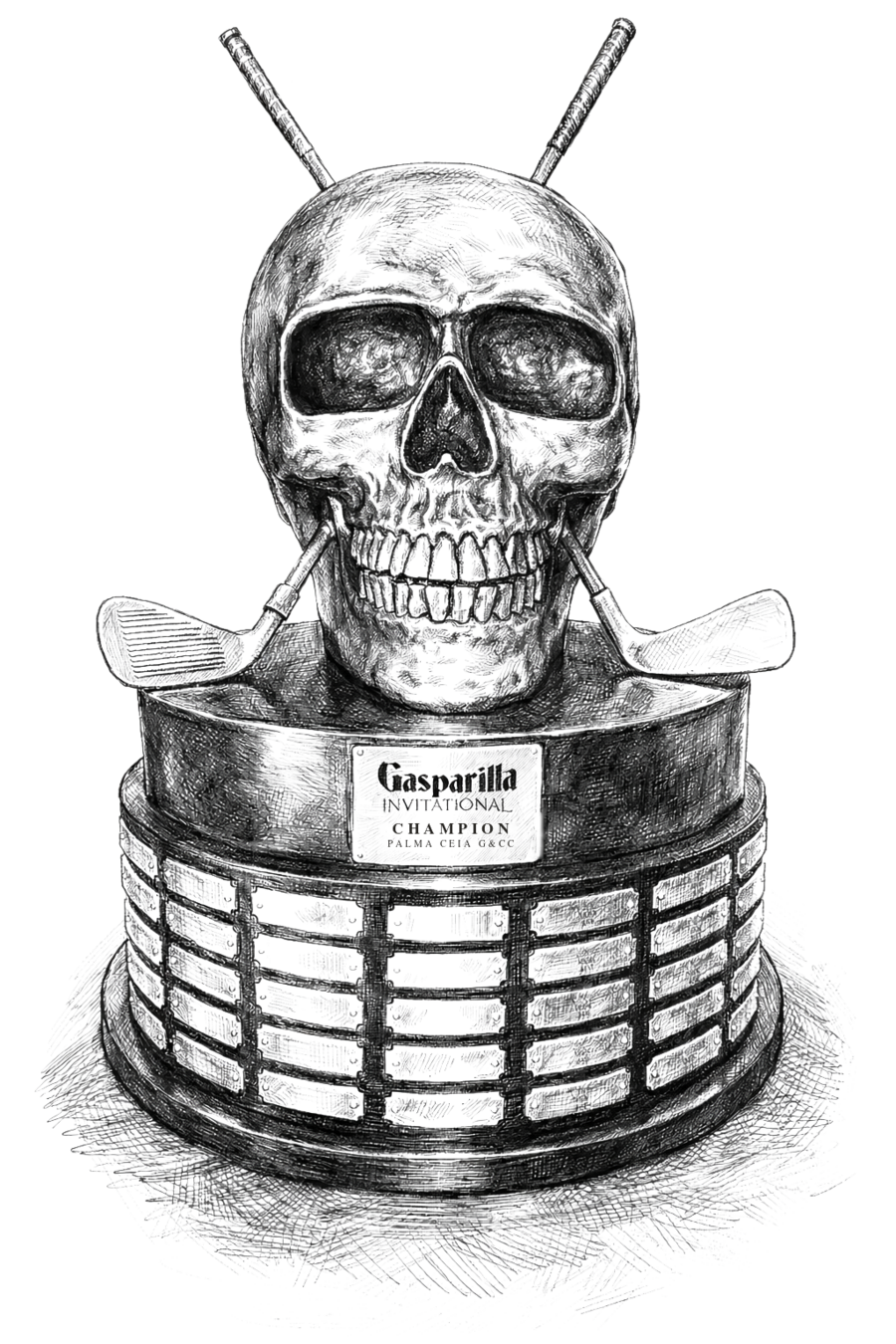
The championship trophy, introduced in 2015 — a skull and crossed clubs, in the same spirit as the crest above.
Reimagined
By the early 2010s, the Gasparilla had fallen out of the national conversation. In 2015, Executive Director Chuck Davis set out to change that, rebuilding the tournament's standing among the country's leading amateur invitationals — a return that depended on tightening who was invited to play. The reasoning was direct: put the best mid-amateurs in the country in front of Palma Ceia in February — a strong course, a membership willing to support it, and Florida sunshine in the middle of winter — and the tournament would sell itself the year after. The stakes were plain at the time: elevate the event back to national caliber, or return the week to the membership. The standard Davis set that year has held ever since, carried forward under Kevin Dutkowsky, who joined the tournament that year and has served as Executive Director since 2022.
The relaunch also gave the tournament the identity it carries today. The skull-and-crossed-clubs mark, introduced in 2015 alongside the championship trophy still awarded each year, was later featured by AmateurGolf.com in its roundup of the best tournament logos in amateur golf — leading the list, with the site calling its pirate-lore origin story simply "the best."
The Gasparilla Invitational, Now
The Gasparilla draws one of the strongest fields in amateur golf every February — a tournament that exists in its current form because Chuck Davis and a forward-thinking committee chose to rebuild it, with the full support of Palma Ceia's Board of Directors behind them. Their work carries a direct line from Paul Runyan's gold coins, to Walter Hagen's last stand, to Hal Sutton's final amateur round, to the trophy raised each year on the 18th green.